Showing posts with label Mandatory. Show all posts

Thursday, January 19, 2012

Art


Art can serve very many diverse purposes. Most of the time, it serves a purpose connected in some way with emotion. It can serve simply as a personal release of emotion for its creator. It can also convey its creator's emotion to its viewers. Most of the poems we have studied in class probably have fallen into one of these two categories. Sometimes, the artist creates the art for a specific purpose, whether to rally the public after a loss, or to convey some of the artist's experiences to those who do not share them (like the poem "110 Stories" that we read). Thus art can have a practical purpose as well as a purely artistic one. Some art, however, does not stem from the artist's emotion, but, rather, is intended to incite emotion on the part of its audience. For example although Beethoven's "Pathetique" Sonata often causes emotion in its listeners, I  doubt that Beethoven was feeling those same emotions as he wrote it, if only because music of that quality usually requires too much planning to be composed on a whim. Then again, given who he was, it is actually quite possible, even probable, that he wrote it spontaneously. Anyway, whether this piece is an example or not, it is true that for some art, emotion is the goal, not the source.
There is also a second main purpose of art (emotion was the first): creativity. Not all art comes from or creates emotion. Some art is simply created for its own sake, or for the sake of novelty and wonder. Quite a lot of music fall under this category, as does some twentieth-century visual art, like the painting above: Yves Tanguy's The Ribbon of Excess. These works of art perpetually amaze their audiences, who marvel at the ingenuity and creativity of the artists. Therefore, actually, this art, too, inspires emotion among its viewers, this time emotions of worder and amazement.
http://en.wikipedia.org/wiki/John_M._Ford
http://www.all-about-beethoven.com/patetica.html
http://www.nationalgalleries.org/collection/artists-a-z/T/6084/artistName/Yves%20Tanguy/recordId/24051

Tuesday, December 20, 2011

Book Recommendation (for class)

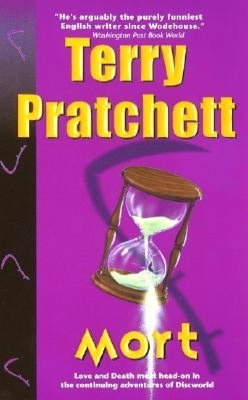
Over Christmas break, I strongly recommend that each one of you read something, preferably a book of some quality and substance. My recommendation for you is to read any of Terry Pratchett's Discworld novels. While not "high literature", to be certain, they are quite substantial in their own way, and make a good diversion in times of lethargy. Each individual book is a quick read, but there are many worthwhile selections to choose from. A good starting place might be Mort, which, while the fourth book in the sequence, is a starting place of its own and one of the better selections of his early novels. This book, like the rest of his, develops a good plot and characters while still remaining light and humorous.I suggest that all of you read it, and maybe, if you like it enough, you will read some more of his too.
(Apologies for not having the amazon link. For some strange reason my computer blocked the site.)

Saturday, November 19, 2011

Chaucer's Characters

Out of all the caracters in The Canterbury Tales, the one most likely to endure the longest is the knight. The main reason for this is that the knight is the least complicated out the characters: he is just an exaggerated knight. He seems to be the embodiment of the medieval era, chivalrous and polite, but, as he appears to the reader, is constantly either off on some crusade or making a pilgrimage to some holy site. (This inferrence comes from the observation that the knight appears to have come straight from battle, pulled of his armor, and headed straight for Canterbury. Thus, it seems like fighting and going on pilgrimages are all he does.
Such a one-dimensional character will find it hard to vanish from our culture, as it is so easy for writers to churn out yet another cookie-cutter knight. Other, more complex, characters may eventually disappear, as writers stop using the exact combination of attributes that makes up the archetype, but the knight will not, because a charater who does nothing but act "heroic" will always exist in some form or another.

Wednesday, October 5, 2011

Anglo-Saxon Boast

Challenge:

"Seriously? Alex Mason won? There must not have very much competition at that contest, because I'm sure he couldn't even jump over that pencil on the floor.

Boast:

"So I've been hearing people saying that you think that I can't jump over that pencil sitting on the floor. Well isn't that cute. You're saying that I, I who have been practicing jumping over small objects lying on the floor for years, I, who have accepted and won every challenge offered toward the matter, I, who won the world writing-implement-jumping competition against the world's best needle-jumpers and pen-steppers, could not jump over that nub of a pencil? You must be insane. I am the One Who Has Seen The Upward-Facing Sides Of Pencils From An Angle Perpendicular To The Floor On Which We Stand, the Crosser-Over-er Of All That Is Long, Thin, Roughly Cylindrical And About One Centimeter Thick! Before I am done, I will have jumped over every obstacle of this nature in existence!
This pencil will hardly be the greatest challenge I meet. If you don't flee in order to avoid embarrassment as I easily overcome this insignificant challenge of yours, you will see me jump RIGHT OVER THAT PENCIL!!! Then, not even taking even the smallest of rests, I'll do it again, right as you watch! You tripper-over-lint couldn't hope to match it, not if you tried a thousand times. After I am done, I will thank God for letting me pass this pencil's crest without falling over it like one of you, for the day you lint-trippers dissapear, I'll be out of a job.

Wednesday, September 28, 2011

Values of Modern America (edited)

It is a common belief that the core values we have today are somehow better than 7th century Anglo-Saxon ones, that ours are less "shallow" and more important. Is this belief really true? Are we any better off, in terms of what we see as ideal, than 600's England? On the contrary, it seems to me that we have circled back around to where we started.
The Anglo-Saxons greatly prized heroism, so much that practically the only literature we have from them is epic tales of heroes, like Beowulf. However, this heroism was less like the heroism we might think of today and more like simple expressions of one's physical prowess by fighting evil creatures. At first, with a glance at what we consider heroism today, this seem changed completely. However, one has only to ask what most of today's high school students place first. The answer is their athletics. This modern athleticism is the direct parallel to yesterday's heroism.
The Anglo-Saxons valued art, but only so far as it pertained to war. They carved intricate patterns and pictures into their armor, but little else.Today's Americans also value art, but only as far as it is easy to digest. We listen to mass-produced music and think a photograph much better than a painting. Consumerism has returned us to a limited understanding of art.
Thirdly, just as the Anglo-Saxons believed in fate, so, in a way, do many of us. As learn more and more of the biology of the brain and of societal influences, more and more people have concluded that we are not as in control of our own life as we seem. While this link is weaker than the other two, it is still worth bringing up.

Tuesday, September 27, 2011

Values of Modern America

It is a common belief that the core values we have today are somehow better than 7th century Anglo-Saxon ones, that ours are less "shallow" and more important. Is this really true? Are we any better off, in terms of what we see as ideal, than 600's England? On the contrary, it seems to me that we have circled back around to where we started.
The Anglo-Saxons greatly prized heroism, so much that practically the only literature we have from them is epic tales of heroes, like Beowulf. However, this heroism was less like the heroism we might think of today and more like simple expressions of one's physical prowess by fighting evil creatures. At first, with a glance at what we consider heroism today, this seem changed completely. However, one has only to ask what most of today's high school students place first. The answer is their athletics. This modern athleticism is the direct parallel to yesterday's heroism.
The Anglo-Saxons valued art, but only so far as it pertained to war. They carved intricate patterns and pictures into their armor, but little else.Today's Americans also value art, but only as far as it is easy to digest. We listen to mass-produced music and think a photograph much better than a painting. Consumerism has returned us to a limited understanding of art.
Thirdly, just as the Anglo-Saxons believed in fate, so, in a way, do many of us. As learn more and more of the biology of the brain and of societal influences, more and more people have concluded that we are not as in control of our own life as we seem. While this link is weaker than the other two, it is still worth bringing up.